



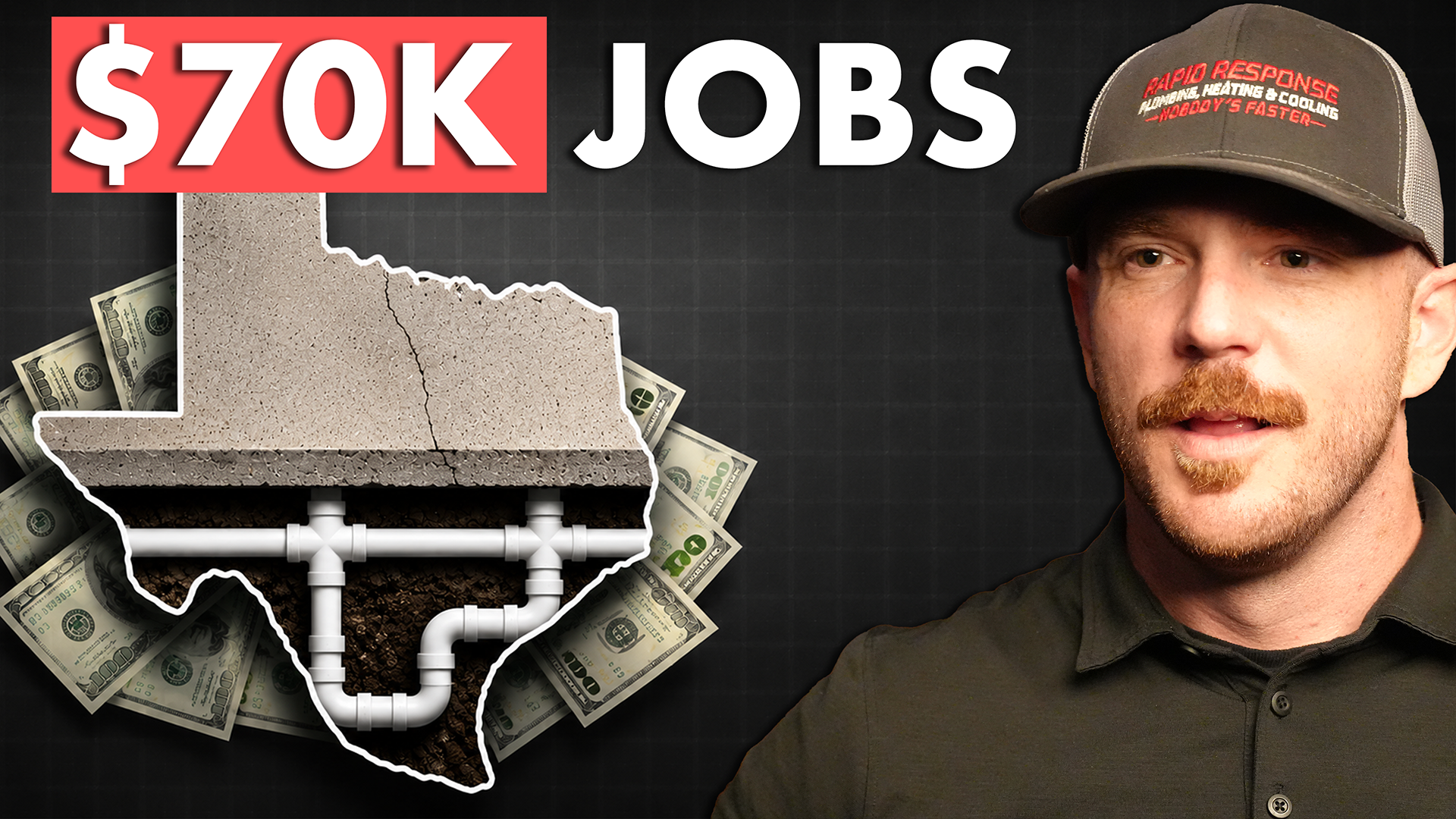
Why would someone choose plumbing over HVAC in Texas?
In this episode of JackQuisitions, Jack Carr explains why he'd buy a plumbing business over any other home service company in Texas. The opportunity is driven by the unique combination of expansive soil, slab foundations, buried sewer lines, and the referral ecosystem that surrounds foundation repair.
Jack breaks down how hydrostatic testing can become the entry point into high-value plumbing work, why owning the diagnostic relationship creates a durable competitive advantage, and what he'd look for when acquiring a plumbing company built to capitalize on this niche.
━━━━━━━━━━━━━━
In this episode, Jack covers:
• Why plumbing is his #1 home service acquisition in Texas
• How foundation movement creates recurring plumbing demand
• The business opportunity behind hydrostatic sewer testing
• Why diagnostics can lead to high-ticket repair work
• What to look for when acquiring a Texas plumbing business
━━━━━━━━━━━━━━
Follow Jack for More Acquisition Insights
━━━━━━━━━━━━━━
Breaking $5M Workshop
Join John Wilson and Jack Carr in Akron, OH for a hands on workshop built for home service owners ready to scale past $5M. Get the proven playbook, tour Wilson's operation, and connect with other growth minded contractors. Register here: https://www.ownedandoperated.com/upcoming-events/oao-workshop-breaking-5-million
Jackquisitions Newsletter — Your favorite source for how to buy small businesses. Real insights, smart strategies, zero gurus.
🖊️ Sign up HERE for more insights
📢 Enjoyed the episode?
✅ Like, Comment & Subscribe for weekly insights on business acquisitions, deal flow, marketing, and growth strategies!
📌 Disclaimer: Some links may include UTM parameters or affiliate relationships, meaning we may earn a commission if you make a purchase. Episodes may feature sponsors, but all opinions expressed are our own.
If I had to buy one home service business in Texas, I would buy plumbing. Not HVAC, not roofing, not pest control, plumbing. And one of the biggest reasons is sitting underneath the Texas home. Sewer lines buried below concrete slabs and soil that moves. Now, the start. I need to kill the exaggerated version here. Immediately. Texas does not have some kind of blanket statewide requiring law that makes every home do a sewer test after foundation work. Testing may or may not be required or requested by municipalities, engineers, foundation companies, warranty providers, or real estate transactions. But the opportunity is actually better than some government mandate.
Texas has a structural problem that repeatedly creates plumbing work. Large parts of Texas have expansive soil. The soil absorbs moisture and swells, then it dries out and contracts. And the Texas Department of Licensing and Regulation identifies this shrink and swell behavior as a common cause of foundation repair. Now, combine that soil with slabs, slab on grade construction, and plumbing lines running underneath the house. When the foundation moves, or when the foundation company lifts and levels the house, the plumbing becomes a major question. Did the sewer fitting separate? Did an older line crack? Was the leak already there? Did the foundation company make it worse? That creates demand for hydrostatic sewer and water testing. Technically, you are not pressurizing the sewer in the same way you pressure test a water line. The drain system is isolated, plugged, and then filled with water, and then determine how much of that water drops.
And here's the critical business advantage. The Tennessee, excuse me, I'm in Tennessee, the Texas Real Estate Commission says only licensed plumbers may perform a hydrostatic test on a system with a home. The foundation company installs some piers, the structural engineer comes out to evaluate the movement, and then the home inspector identifies the warning signs. But when everyone wants to know whether the sewer system holds, they need to contact the plumber. And if it doesn't, guess who gets the work? Usually that plumber. And this puts the plumber in a super valuable position between the foundation company and the homeowner, the engineer, and sometimes even the real estate transaction itself. And that is before you considered like the normal plumbing demand of water heaters and clog drains and leaking pipes and remodels, like that's a huge benefit because the foundation to sewer system equal sewer ecosystem is simply the Texas specific
kicker. I would not buy some generic plumbing company and just hope that the phone rings. I would build a company around this sewer and foundation wedge, and then I would feed that into broader plumbing operations. Because the customer journey is straightforward. First, the company performs a pre-foundation and post-foundation hydrostatic test. If the sewer passes, the homeowner receives documentation and the company acquires a new customer. You get some water heater work later on, maybe a new repipe. If it fails, the plumber moves into isolation testing. Which bathroom's leaking? Is it a branch line? Is it a section underneath the slab? And then comes a sewer camera, locating equipment, and repair plan. From there, the work might become a spot repair, excavation, tunneling, under slab work. And this work can be $50,000, $60,000, $70,000. It's huge tickets, and a relatively small diagnosis can therefore create multiple generation revenue generation events. There's the initial hydrostatic testing, there's the isolation and locating, there's the repair, there's the tunneling and excavation. And finally, if it all went well and the customer's happy with you, future plumbing work. What's important here in the moat is going to be your referral network, right? You want referrals from foundation repair companies and structural engineers and real estate agents and home inspectors and property managers and restoration companies. And the pitch is simple. It's like, hey, you we schedule quick, we document everything, we almost have no callbacks, we do a lot of communication, and we won't cause panic to your customers. The last part matters because like referral partners who do not want a plumber who's gonna just show up and do 20,000, 50,000, 20,000, 50,000. They want you to actually go through the locating process and document and make sure that everything is really tight so that for either insurance purposes or for homeowner purposes, they want to look good as well. What is not necessary is to self-perform everything. So a lot of these plumbing companies they have subcrews that do their tunneling for them. Uh, a strong, a strong subcontractor can handle the digging while the plumbing company owns the diagnostics, the repair scope, the plumbing work, and the customer relations. As an acquisition, I would look for a few key things is a master plumber, maybe who's looking to retire. The business has several competent service technicians, strong local reviews, and existing drains and sewer capacity, or someone who knows how to do it because it's it's a huge gig, but maybe something with like a little bit weaker marketing or no organized referral program. So that'll give the operating platform like a clear lever on how to grow, not a business that just invents from zero.
So the downsides to this business though, plumbing is not an easy business because the demand is attractive. Like this is a this is worth the $20,000, $30,000, $40,000 dig jobs because it is hard work and there's a big licensing hurdle, there's a big labor hurdle. You can't scale the company around one eight aging master plumber whose license relationships and technical knowledge disappear when they leave. So before buying the business, you have to verify who exactly holds the license, whether that person is going to stay or sub that license out to you, qualify for you, and if there's a bench or like a team who can actually get their license later on. And the second problem is liability. Foundation and sewer work, the homeowner says the foundation company broke a pipe, the foundation company says the leak was already there, the plumber gets stuck in the middle, and that's why all this documentation that I mentioned earlier is so incredibly valuable because you need to be able to record the test authorization, the water level, the test duration, isolation methods, camera footage, locate markings, and test results. The third problem is reputation risk. The plumber diagnosing the leak may also be selling the repair. So this creates an obvious conflict of interest in the homeowner's mind. Sometimes you can work that to your advantage. Sometimes it could come off bad if you don't have good sales techniques for your technicians. So the technicians can't exaggerate findings, they can't skip the isolation process or not show the evidence clearly. They need to go through the process correctly to be able to avoid all those reputation problems. What business would I buy in Texas? Not because it's glamorous, not because it prints money though it might, and not because Texas law guarantees hydrostatic testing has to be done. But I would buy plumbing in Texas because Texas creates a powerful combination of moving soil, slab foundations, buried sewer systems, foundation repair, and recently lots of real estate transactions that uncover those problems. So there's a large network of professionals who need reliable plumbers and have something beneath the house that might be leaking. The best version of this company is not waiting around waiting for toilets to clog or waiting for water heaters to leak. It's to own the diagnostic relationship. It's to becoming the plumber that companies trust, that foundation companies trust in engineers, trust and real estate professionals to trust, and to own that B2B lead gen arm and then to get really good at hydrostatic testing as well as all other plumbing methods. That's my strategy if I were to buy in Texas. That's the business I would buy in Texas today. If you like what you heard, like, subscribe, share. If you think I'm wrong, because you own a company or you do hydrostatic testing, comment in the section below why I'm wrong. Appreciate it guys. Until next time.

.png)
