



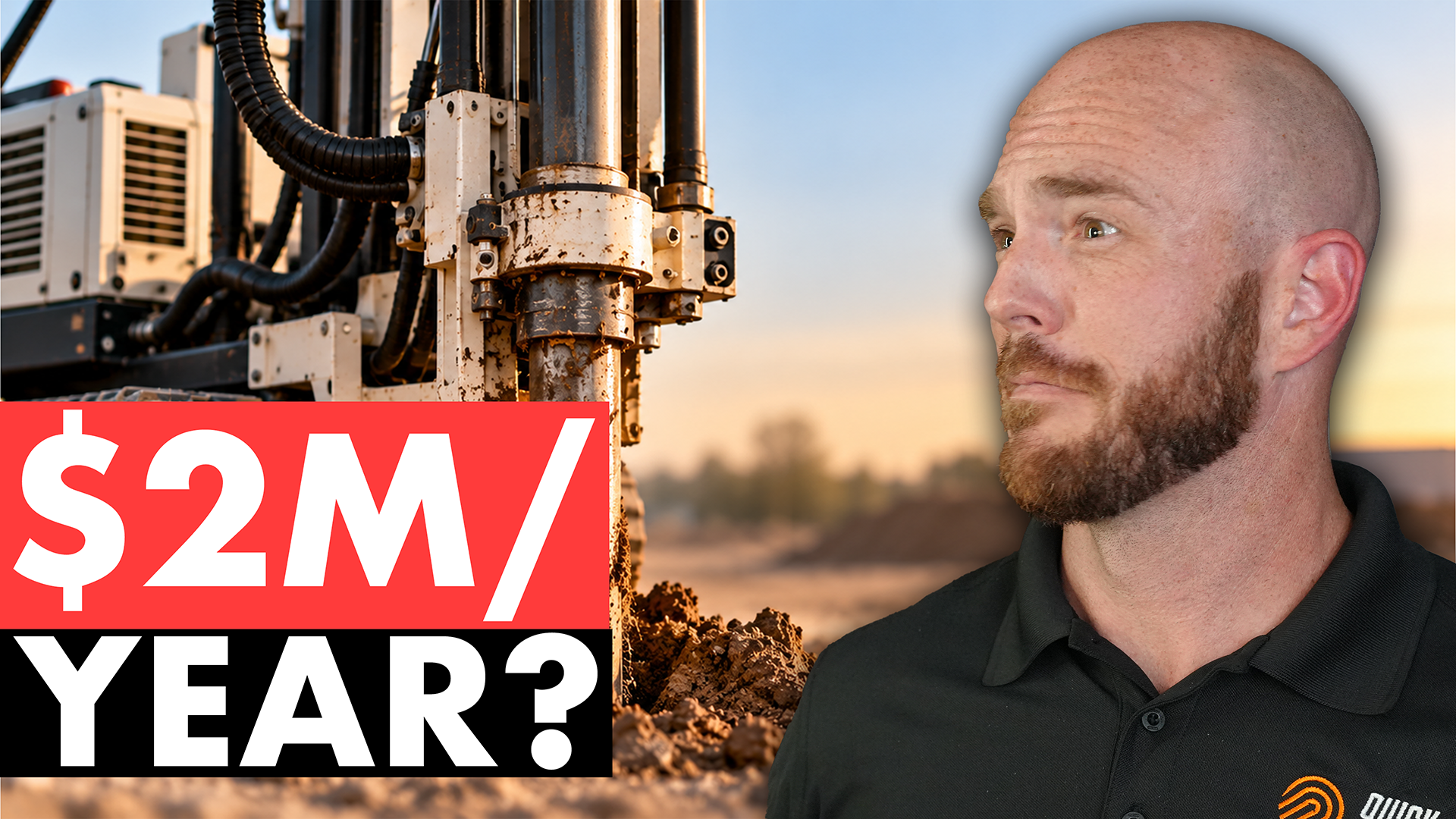
You can build a $2 million business drilling holes in the dirt, and it has nothing to do with oil or water wells.
In this episode of JackQuisitions, Jack Carr breaks down the business of environmental and geotechnical drilling, where specialized crews use equipment like Geoprobes to collect soil, groundwater, and rock samples for environmental consultants, engineers, contractors, and government agencies.
Jack covers how these companies make money, what drilling equipment costs, why a small group of repeat engineering firms can create a strong customer base, and why he’d rather own the drilling subcontractor than become an environmental consultant.
━━━━━━━━━━━━━━
IN THIS EPISODE
━━━━━━━━━━━━━━
• How environmental and geotechnical drilling works
• How drilling companies make money
• $100K–$400K specialized drilling equipment
• Environmental sampling and monitoring wells
• Geotechnical drilling and soil testing
• Why engineering firms outsource drilling
• Building a repeat B2B customer base
• How Jack would start and scale the business
• Why he’d stay a subcontractor instead of consulting
━━━━━━━━━━━━━━
Follow Jack for More Business & Acquisition Insights
━━━━━━━━━━━━━━
Catalyst | May 3–5 | Akron, Ohio
100+ home service owners and operators. Three days of tactical sessions, real conversations, and learning from great operators.
Grab your seat: https://www.ownedandoperated.com/catalyst
Jackquisitions Newsletter:Your favorite source for how to buy small businesses.
🖊️ Sign up HERE for more insights
📢 Enjoyed the episode?
✅ Like, Comment & Subscribe for weekly insights on business acquisitions, deal flow, marketing, and growth strategies!
📌 Disclaimer: Some links may include UTM parameters or affiliate relationships, meaning we may earn a commission if you make a purchase. Episodes may feature sponsors, but all opinions expressed are our own.
You can build a $2 million a year business just drilling holes in the dirt. But wait, I'm not talking about oil wells or water wells. I'm talking about environmental and geotechnical drilling. I'm talking about these guys show up at gas stations and laundromats and warehouses and construction sites and old industrial properties to figure out what's under the ground and under the concrete slab. This isn't some tiny theoretical niche. Uh a 10-person environmental consulting and drilling company in Kansas City just sold this year. It was doing $2 million in top line and $400,000 in cash flow when it sold. By the end of this video, I'm gonna explain why if I started this company, I wouldn't become an environmental consultant, though. I would just want to be a boring subcontractor that every consultant needs. In this video, we're breaking down the business of environmental and geotechnical drilling. What do these companies actually do? Imagine you buy an old gas station. The environmental consultant thinks that there might be a leak underground in a gas or in one of the tanks. They need to know if gasoline is sitting in the soil or the groundwater before you buy. A drilling company shows
up with something like a geoprobe and drives tooling into the ground, pulls soil and groundwater samples at different depths, the soils go off to the lab, and now the consultant can figure out where the contamination is, how far it moves, and what needs to happen next. The same equipment, though, can be used at dry cleaners and factories and landfills and redevelopment sites and military bases, and basically anywhere where somebody needs to understand what is beneath the property. Environmental drillers commonly perform soil and groundwater sampling. They install monitoring wells and look at site characteristics. Then there's the whole geotechnical side of the business where before someone actually even builds a warehouse or an apartment building or a bridge or highway or an engineer needs to understand the soil and the rock composition and what actually supports it. So the driller
performs soil boring, spit spoon samplings, standard penetration testing, rock coring, and other subsurface investigation. Different customer, same basic idea. The engineer needs information from underground. You own the machine that gets it for them. And this is where the business gets interesting. This is not a flat rate product. You charge for mobilization, you charge for daily rig rate, you charge by drilling by the foot, you charge by number of cores, you can charge for monitoring the well installation and additional labor and materials and standby,
decontamination, other field services. There's a public geoprobe contract from Suffolk County that priced it around $2,000 a day, then separately charged for monitoring the well. So there is a $2,000 single-time fee plus a monitoring charge for reporting and additional labor. These larger projects can get extremely large. New York City recently awarded a $1.5 million contract for land and marine boring used to collect soil, rock, and groundwater samples for highway projects. And another 2026 city solicitation for drilling and subsurface irrigation carried a ceiling of $5 million. So the real institutional money is being spent here. But there's always a downside. Let's talk about the equipment cost. A used GeoProbe 7822 DT can sell for around almost 100 to 200,000 depending on the age and setup. And a larger 3230 DT I found was asking almost $400,000.
And that's real capital. But at the end of the day, I like a portion of this barrier to entry because this is not pressure washing or mowing lawns where you can have 2,000 competitors. Like this is highly specialized equipment and you need people who actually know how to operate it. But the thing I really love to see is the customer base because the customer base, it can be the property owner, but it's usually not the property owner. It's these environmental consulting groups and geotechnical engineering and civil engineering and government agencies, launch contractors managing these projects. And those companies need drilling constantly. It means like you don't need 10,000 customers. You need, you know, realistically 20, 30 good customers and good engineering and environmental firms where they're just going to keep you on rotation, running these jobs frequently. This also creates a natural expansion path, right? So you start with the direct push environmental work, then you add some monitoring and well of well installations, add the hollow stem auger capacity or geotechnical sampling, add rock coring and difficult access equipment. Eventually, you can have multiple rigs covering a slew of different job types without completely changing your customer base. That's what gets me to what I promised at the beginning. Because if I started this business, I would resist the temptation to become an environmental consultant. I want five different engineering firms winning projects, and I want all five of them calling me to do the drilling. They don't
want to own this equipment. They just want to sub you out to drill rather than spend the $400,000 it takes to buy that equipment and to hold the specialized trainings and to manage the people that do the drilling. They just want the best subcontractor in the market who answers the phone, shows up when promised, keeps the equipment running and clean, documents everything correctly, and then becomes incredibly easy for the engineers and consultants to work with. Because the weird thing about this business is that the customers aren't really paying you to drill a hole, they're paying you to turn something that nobody can see underground into information that can make multi-million decisions on real estate and building projects and huge contracting jobs. And as long as we keep buying and selling and cleaning up and building on land, somebody is going to have to drill these holes. If you like what you heard, if you like geotechnical drilling, if I just freaking missed something and you're the best geotechnical driller in all the United States, comment below. Uh, want to hear your thoughts, like, sub, and I'll see you on the next one.
.png)

.png)
