Most people look at a construction site and see the companies building it. Jack Carr sees five overlooked businesses making money behind the scenes.
In this episode of JackQuisitions, Jack breaks down five construction support businesses he'd consider owning: temporary fencing, portable toilet rentals, traffic control, temporary power, and job site security.
These businesses solve problems contractors already need handled. Jack explains how equipment rentals, recurring service contracts, and long-term relationships with general contractors can create opportunities to generate repeat revenue without doing the actual construction.
He also explores why job site security is particularly interesting as AI-powered surveillance and remote monitoring change how construction companies protect their equipment.
━━━━━━━━━━━━━━
IN THIS EPISODE
• Temporary fencing and recurring equipment rentals
• Portable toilet rentals and route-based sanitation services
• Traffic control businesses serving contractors and municipalities
• Temporary power, generator rentals, and job site infrastructure
• Job site security, AI surveillance, and remote monitoring
• Why construction support businesses can generate recurring revenue
• Building long-term B2B relationships with contractors and developers
• Why Jack likes owning the businesses behind construction
━━━━━━━━━━━━━━
Connect With Jack for More Business & Acquisition Insights
━━━━━━━━━━━━━━
Jackquisitions Newsletter:Your favorite source for how to buy small businesses.
🖊️ Sign up HERE for more insights
📢 Enjoyed the episode?
✅ Like, Comment & Subscribe for weekly insights on business acquisitions, deal flow, marketing, and growth strategies!
📌 Disclaimer: Some links may include UTM parameters or affiliate relationships, meaning we may earn a commission if you make a purchase. Episodes may feature sponsors, but all opinions expressed are our own.
Everybody looks at a construction site and sees the obvious businesses. But when I look at a construction site, I see something completely different. I see the other companies, the fence around the property, the portable toilets, the cameras watching millions of dollars of equipment. These are the businesses I love. They're boring, they're B2B, and customers already understand that they need them. There's no education involved. So today, here are five profitable businesses that are hiding on almost every construction site. And some of these might be actually better business than doing the construction
itself. Number five, temporary fencing. Walk around almost any decent sized construction site. And the first thing you'll see is a fence. Construction companies need to control who comes and goes from the site. And depending on the size of the project, how big it is, whatever, the fence could sit there for six months. It could sit there for a year, it could sit there for even longer. And that's what makes temporary fencing interesting because you aren't selling a fence, you're renting access control, right? The contractor calls and you deliver the panels and the crew sets everything up. And then those exact same panels sit there and you collect rent on them while you're setting up another fence somewhere else. There's so many opportunities in temporary fencing. And that's even before you start touching gates and privacy screens and traffic barricades. You're basically building an equipment rental company around something no one else is excited to own. I love a business like that. The customer doesn't wake up wanting temporary fencing, they just need that problem handled.
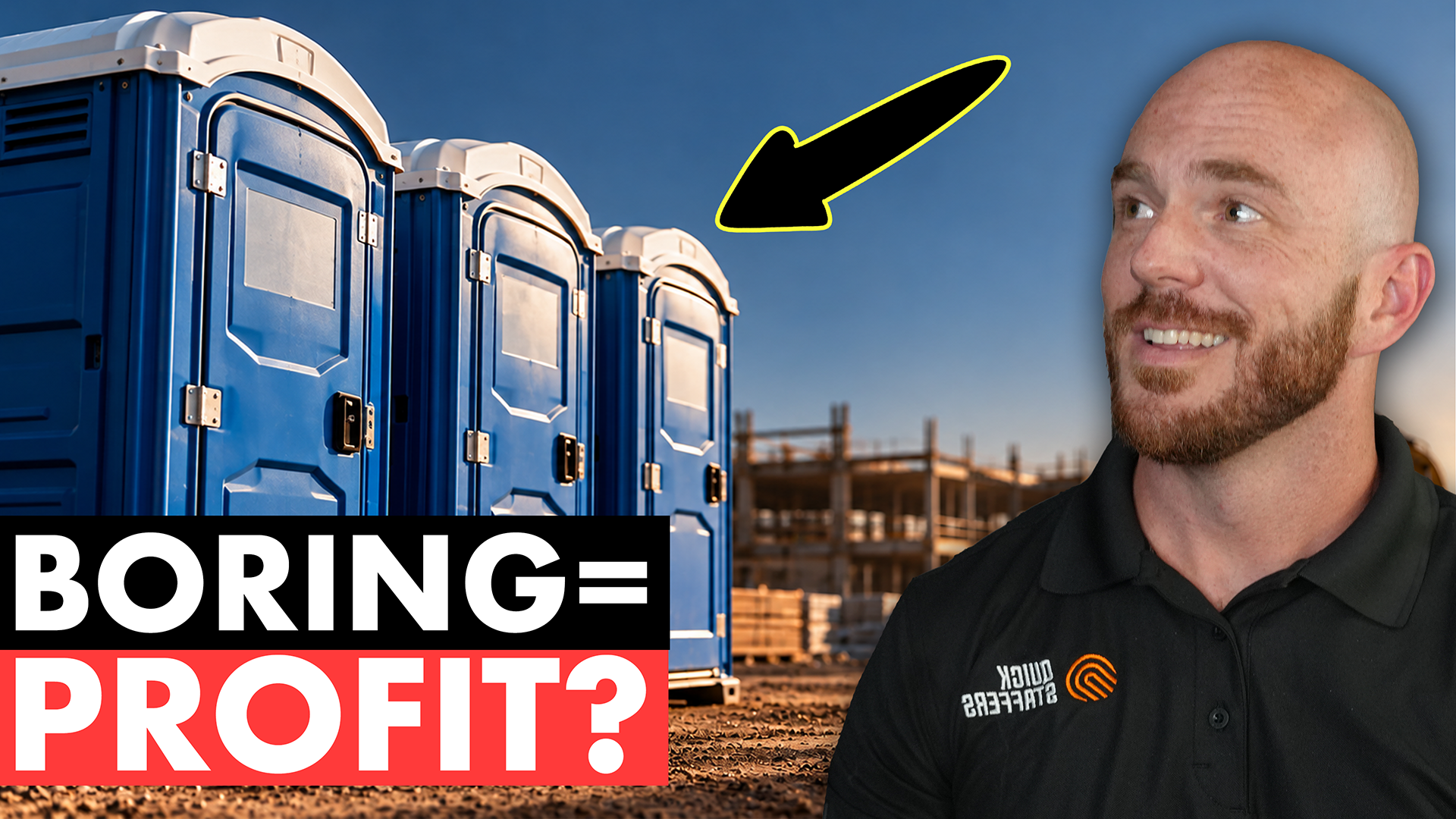
Number four, job site sanitation. Portable toilets need pumping. And everybody on that construction site needs somewhere to go to the bathroom. And unlike the drywall contractor or the roofer, like you don't finish your part of the project and then leave. The toilet stays there. Again, just like the fences, it stays week after week, month after month, which means that the relationship with the contractor is based around servicing a site over and over again. And this is where the route business is disguised as a construction business. Drop the units, build a recurring schedule, clean them, restock them, move on to the next stop. And once you start thinking about it in that way, the biggest advantage isn't actually the toilet, it's density, it's dirty, it's repetitive, and most people don't want anything to do with it. Those are usually three things I like hearing when someone pitches me on a business idea.
Number three, traffic control. You've probably been annoyed by this a hundred times and haven't even thought about what goes into it. I love this business. A utility contractor might be fantastic at installing fiber, but the second that their work interferes with traffic, somebody has to stop cars and safely move pedestrians around the job site. So they call a traffic control company. And that company delivers equipment and delivers labor. They set up the work zone, they hire the flaggers, they move the barricades, maintain all the signage, then they tear it down and go to the next project when the project moves. What I really like about this is how embedded it is in every bit of construction and how intensely involved it is with every single contractor. I want one traffic control company that I trust that does a good job, that hires good people. So once I become that vendor, I'm just following the customer from site to site all year long. And this is for utility contractors and municipalities and road construction, telecommunications, and plumbers and water and sewer and paving and emergency repairs and everything that touches roads all the time. And it's a very, very good place to sit in the value chain. Don't get me wrong, it's a hard one, but it's very good if you can figure it
out. Number two, temporary power. This is one of those businesses, just like traffic control, that once you notice it, you will see it everywhere. A construction project starts, there's no electricity where everybody needs it. And I'm not talking about like a small little generator here and there, but I'm talking about big construction sites. The job still has to run, the crews need lighting, tools need power, trailers need power. So somebody has to create this temporary infrastructure on site. I'm talking generators and temporary distribution panels and cables and transformers and power poles and fuel service and monitoring, setup and maintenance, emergency response when something goes down. And the project might need that for months, usually needs that for months. It's almost never short term. They're calling you because if the site loses power, the crew stops working or millions of dollars in product comes to a halt. The value isn't electricity, the value is uptime in a lot of situations. And there's multiple markets beyond just traditional vertical construction. I mean, there's, like I said, infrastructure projects and disaster recovery and industrial shutdowns and large events and remote job sites and utility work, basically anywhere where somebody needs a substantial amount of power without permanent infrastructure that's already in place. And that's an interesting business to me because you're providing something that's extremely boring until it stops working. And then suddenly you're the most important vendor in the entire world on that job site.
And number one, think about what is sitting on a construction site after everybody goes home. You have millions of dollars of equipment sometimes: excavators and skid steers and copper wire and tools and generators and fuel and HVAC equipment, lumber, and appliances, and sometimes millions of dollars in partially built stuff just sitting on construction sites. And then everybody clocks out and goes home. That's the problem. So construction companies are increasingly using dedicated job site security. You can deploy multiple surveillance towers that are now AI-backed and motion detectors and remote monitoring and access control and license plate cameras. Like all of this new stuff is coming out and is making this industry much more ripe for disruption. Drop the equipment at the beginning of a project, you monitor it, you service it, and move it when the job site changes. Pick it up and deploy it somewhere else. I mean, we've hit it this now three or four times. Same basic model that we saw with fencing. You drop something off, and for very obvious reasons, the customer keeps paying. One stolen skid steer can become a massive headache dealing with the cops and dealing with insurance companies. One theft can wipe out more money than was already in this project. And so once you establish a relationship with these general contractors and developers and equipment yards, you're not just winning one site, like you're the vendor that gets to follow them to every project that they build. And that's where this business gets super interesting. And that's why I really love the theme behind this entire list, but specifically this project the convergence of technology into a historically labor-intensive business is gonna revolutionize this part of the industry. That's the theme behind this whole list, though, is when people look at construction, they look at the trades physically building the building. I want to know about everything behind it. If you like what you heard, leave us a five star review, like, comment, share, talk about whatever we talked about below. If I missed something, I mean it is like a seven minute video, so give me a break. But if I if you want to comment on it, leave it below, and I will catch you all next time.