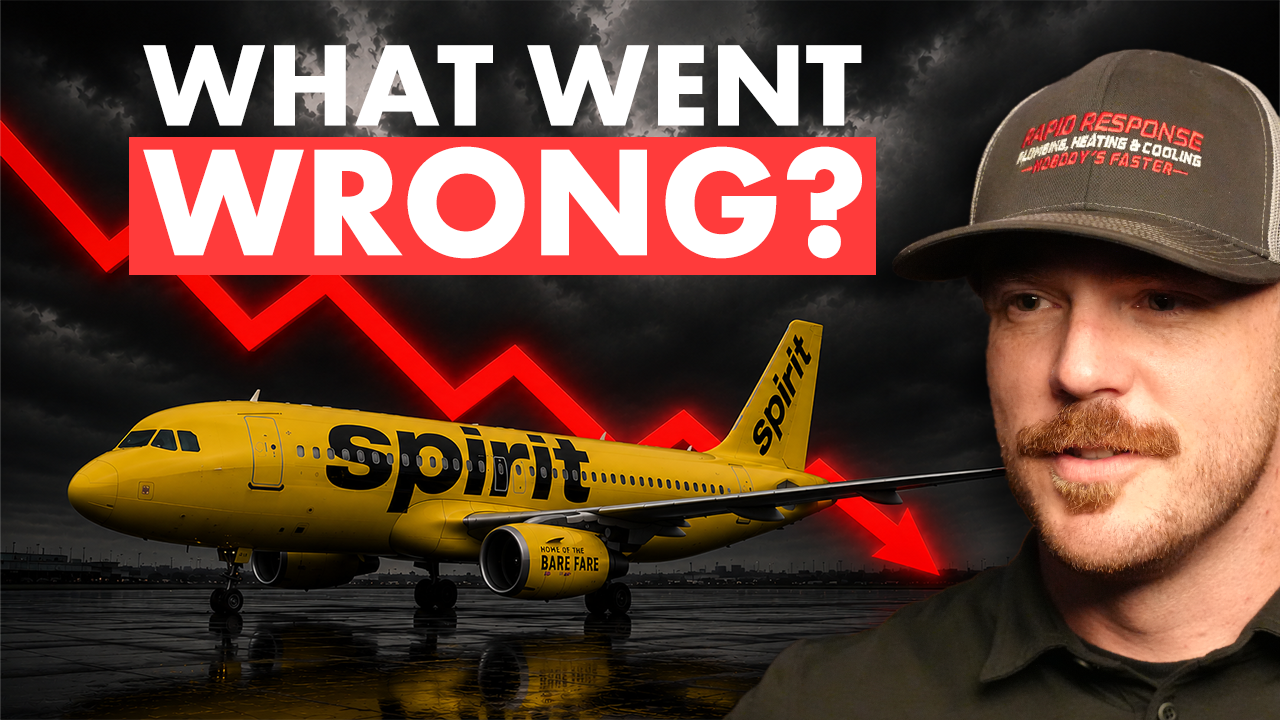
Spirit Airlines didn’t fail because people stopped wanting cheap flights. It failed because the business model eventually stopped working.
In this episode of Jackquisitions, Jack breaks down how Spirit built an airline around ultra-low prices, backend fees, and stripped-down customer experience—and why that strategy ultimately collapsed under rising costs, customer frustration, and shrinking operational margins. From fuel prices and labor inflation to branding, loyalty, and the dangers of competing only on price, this episode explores one of the most interesting business case studies in recent years.
In this episode, we cover:
Why Spirit’s “cheap flights” strategy initially worked
How ancillary fees became the real business model
The psychology behind low-cost pricing and customer behavior
Why customers tolerated the model—until they didn’t
How rising fuel, labor, and debt costs broke the economics
The danger of competing only on price in a low-margin industry
Why “cheap” is a strategy—not a moat
What other businesses can learn from Spirit’s collapse
Follow Jack for more breakdowns:
X: https://x.com/thehvacjack
💼 Special Thanks to First Internet Bank
Looking to buy or grow a business? First Internet Bank is a National Preferred SBA lender focused on skilled trades acquisitions. Get up to 90% financing for acquisitions, partner buyouts, and commercial real estate—plus optional lines of credit for growth.
They take a “how can we” approach, helping both first-time buyers and experienced operators get deals done.
👉 Special Offer: Mention Owned and Operated for a reduced good faith deposit + free deal review & buyside prequalification.
Connect with Alan Peterson: https://alanfib.com/
Jackquisitions Newsletter — Your favorite source for how to buy small businesses. Real insights, smart strategies, zero gurus.
🖊️ Sign up HERE for more insights
📢 Enjoyed the episode?
✅ Like, Comment & Subscribe for weekly insights on business acquisitions, deal flow, marketing, and growth strategies!
📌 Disclaimer: Some links may include UTM parameters or affiliate relationships, meaning we may earn a commission if you make a purchase. Episodes may feature sponsors, but all opinions expressed are our own.
Spirit Airlines did not fail because people stopped wanting cheap flights. It's a lazy take I've seen all over the internet. People just don't want these cheap flights anymore. Spirit failed because of the model. The business model was terrible. You're a cheap company in a brutally tight margin industry, and it's a terrible place to run your business. Because for years, Spirit sold America the dream of this $40 flight, which would be wonderful. Except that the business was not in the flight itself, but in the fees on the back end. Fees for the bags and seat selection and boarding and water and legroom. And then it cut the expenses of every little bit of customer experience while monetizing the rest of it. But Wall Street loved it. Customers kind of tolerated it before they understood and knew and got tired of it. Competitors copied it, but the math ended up breaking because of a few small items, right? Fuel costs went up. Can't have that. You can't run the $49 flight anymore. When now the price per person on fuel is increasing, labor got more expensive, travelers got less tolerant of the BS that came along with it, and the jet blue deal got blocked. So debt started to pile up, and eventually the airline being built around cheap became too expensive to actually operate.
And that's a huge lesson, I think, that most business owners and businesses should leave here with today is cheap is not a moat. Cheap is a strategy. And if your entire strategy depends on your costs staying lower than everyone else's costs forever, you don't have a business. You have a knife fight every single day. Spirit Airlines is one of the more interesting case studies in America for business that I've seen in a while. And it's not because it's loved, uh, because it wasn't loved. People don't like, I mean, that's why I became a meme of terrible customer service. Uh, but but it was never trying to be Delta, it was never trying to be united, it was never trying to be premium, it was never trying to win on service or trying to make you feel good. It sold you on one
thing. If you're buying a business, financing can make or break a deal, which is why I work with Alan Peterson from First Internet Bank. Not only is he a good friend, but he is the best in the business. He's closed over 90 million in SBA loans, specifically in the skilled trades and manufacturing industries in the last year alone. He's the kind of banker that works with how to get this done, not if it can get done. Hit the link in the description below to get a good faith deposit plus a free deal review. He also does pre-buyer qualifications as well. Click it, Alan Peterson, First Internet
Bank. Cheap access to travel. That was the product. So if you're flying from Detroit to Fort Lauderdale for less than the cost of dinner, you're Spirit's customer. But if you want to bring a bag, you pay. You want to pick a seat, you pay. You want to sit with your family, you pay. You have more legroom, you pay. You want normal travel experience, basic 101 expectation travel experience, wrong airline. So, and as funny as people made it, the model is kind of actually brilliant. I know I'm saying it, but in the right environment. After like 2008, 2009, 2010, consumers were super price sensitive post-collapse. Online booking made every flight searchable and comparable. AI came into play. Nobody was sorting flights by best experience, they were sorting flights by lowest price. And we saw this boom from Spirit. They hacked this behavior, but like Southwest did it as well. There's a few great companies that were able to compete in this new space that was a cheap fares got the click market. But they stripped down the product so that it was the bare studs and they advertised it. Uh, the real ticket was built on the back end, and this wasn't a bug, like this was the feature. This was the business model. Uh, because again, Spirit wasn't selling the airline seats. The airline seats was probably a uh lead loss or a break-even, um, but they were selling the entry fee into this travel system, and then the base fare got you on the plane, but everything else is where they made their margin. Um, so that's why low-cost carriers look amazing on paper because they say, Hey, we're we're democratizing travel, we are getting higher volumes than our competitors, and it's partly true, but the business model really is we're going to unbundle everything that used to be included that customers kind of expect with their baseline travel experience. And after you're already committed emotionally to the trip, we're going to charge you for those things, and it's not a ton different from a lot of business models currently in other industries, like gyms do it, software companies do it, credit card processors do it, rental equipment companies do it, contractors do it. Um, they I mean, we do it in some sense, right? Uh for HVAC and plumbing, it's you offer really low diagnostic fee or an entry-level fee that doesn't actually cover the entire, but the real money is made after, it's made on the job itself once you're emotionally driven to make the sale. But the issue is not the upsell, the issue is when the customer feels tricked, and that's where spirit hit this wall of kind of like this dangerous business uh because the brand promise was not we're the best, it was we are cheap. And then once customers felt like the final price wasn't actually cheap, then you have a problem, right? That's the difference between like a gym who does this and or Planet Fitness does this, right? $10 a month to get you in, but then they're selling a bunch of stuff on the back. And hey, you can upgrade to Black member, or you can add family, or you can buy these drinks here. We have all this merchandise. Like, there's you don't feel tricked because at the end of the day, they're still only charging you $10 to use your baseline model. If they're like, Hey, you needed to walk in, oh, you wanted to wear shoes into the gym, another ten dollars. Now, all of a sudden, you get kind of the same experience that Spirit was providing. So, why did this model initially work? Well, it worked because consumer behavior was obvious. They said they wanted a service, they clicked on the cheap ticket, then they said they hated the fees, but they still booked the flight. So people complained online, then they flew again. But the owners of Spirit, the the board, they understood the difference between what customers said and what customers do, right? Customers hate being nickel and dimed, but at the same time, they would still click on the $39 flight and buy it. So this is a very important operator lesson because if you build your what your if you build your business about what your customer says, you can run that versus what they actually buy, you can run into an issue here where survey doesn't meet reality. And I think that happens quite a lot in business.
But to circle back to why it failed, right? Because if it's a great business model, why is it failing? Well, it's failing because they needed one constant to be true, and that was cheap structure, cheap labor, cheap fuel. Everything needs to stay really tight because it's an ultra-low margin business, and they need high utilization of aircraft, dense routes. I mean, it's important to think that the business didn't break from one single thing. Everyone wants, like, hey, this is one silver bullet for why this broke, but it was a lot of things, right? It was fuel labor coming out of COVID. Labor prices went up, uh, inflation went up, fuel went up. It was the government put increased regulations on business, specifically airlines. It was that in conjunction with bad services, right? That they weren't a great like you can't flip the company and pivot at the end of the day because their model is bad service. You're buying bad service, and then on debt service went up, right? Cost of debt, cost of money went from two percent, one to two percent, which is what they're probably borrowing at, to four, five, six, seven, eight percent going into 2024, 2025. So that amount is huge, and all of it combined is what absolutely is brutal. Because if you're Delta, you have loyalty. You if you're Southwest, you have habit and brand affinity. If you're American or United, like you have this networking power, but if you're spirit, all you had was price, that's all you had, and your advantage disappears when the price advantage disappears because you can't stay low dealing with all of those items. So that was the squeeze. Spirit was too cheap to be loved and eventually too expensive to be cheap, and it's a terrible place to be stuck when trying to run a business because the real lesson here is not don't be cheap. Like cheap can work, Walmart works, Costco works, Aldi works. Cheap isn't the problem. The problem is being cheap without durable cost advantage, without loyalty, without enough operational margin for error that if something rises or something happens, you can recover. And that's where Spirit got smoked. It had a fixed cost business model, volume hit a lot of the sins early on. The planes were expensive, whether they were full or empty, cruise cost money, everything went up, and eventually they couldn't run lean enough and they couldn't pivot to make it
work. So now, what does this mean for every other budget airlines? Are they doomed? No, right? Different business models, different time periods, uh, but the pressure's still real, right? Frontier is an obvious name that comes to people's mind because when they think of ultra low-cost airlines, they're next. Uh, but that doesn't mean spirit turns into frontier turns into spirit tomorrow. But the same forces are still applying high operating costs, less consumer tolerance for bad experiences, legacy carriers copying basic economy, and a customer base that's price sensitive but not loyal. So regional airlines will watch those as well. It's a different business model, but the pressure is still ugly. So, takeaways from this is if you're an operator of a business, any business, low price is not a moat. It's strategy, not a moat, but someone can always go cheaper. You can race to the bottom all you want, but if you don't build any of the other experiences, any of the other benefits of a business to your customer base, cheap will not always last because all it takes is a supplier increase, labor increase, one of your fixed costs going up to destroy your business. If you like what you heard, tell me why I'm right, tell me why I'm wrong, drop a comment, leave a like, share it with your mom. I don't know. Uh um if you like these business breakdowns, let me know. Sweet. Let me see what tell me who you want me to break down next. And I'll see you next time.