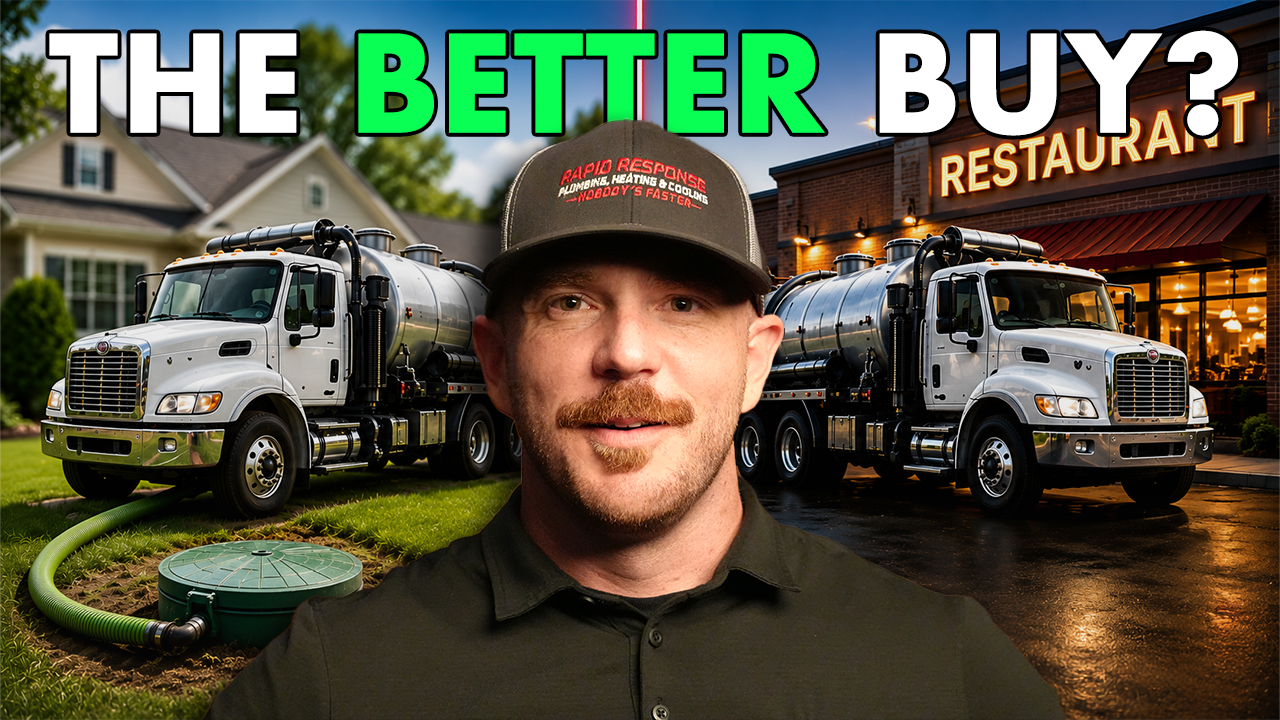
Septic and grease trap businesses look identical on paper. Same truck. Totally different company. Jack Carr breaks down the acquisition framework.Residential septic and commercial grease trap operations share the same equipment — but they are fundamentally different businesses with different economics, different customers, and different risks.
━━━━━━━━━━━━━━
In this episode of Jackquisitions, Jack breaks down everything you need to evaluate a wastewater business before you buy:
• Why grease trap contracts create more predictable, recurring revenue than emergency-driven septic calls
• How route density and scheduling directly impact your margins
• The B2B vs B2C customer acquisition difference that changes your entire growth model
• How to separate revenue streams and evaluate a septic pumping business properly
• Disposal costs, compliance requirements, and the hidden margin killers nobody talks aboutWhether you're looking at a septic truck business, a commercial grease trap route, or a wastewater operation that does both — this is your framework before you sign anything.
━━━━━━━━━━━━━━
Follow Jack for More Acquisition Insights
━━━━━━━━━━━━━━
Jackquisitions Newsletter — Your favorite source for how to buy small businesses. Real insights, smart strategies, zero gurus.
🖊️ Sign up HERE for more insights
📢 Enjoyed the episode?
✅ Like, Comment & Subscribe for weekly insights on business acquisitions, deal flow, marketing, and growth strategies!
📌 Disclaimer: Some links may include UTM parameters or affiliate relationships, meaning we may earn a commission if you make a purchase. Episodes may feature sponsors, but all opinions expressed are our own.
We're back talking poop today. You guys have questions, I've got the answers. So grease traps versus septic. Same truck, completely different business. So most people think that grease trap pumping and residential septic service pumping, they're practically or basically the same business. Some companies will even do both. The big vacuum truck shows up, the hose goes out, something disgusting comes from one tank to the other tank, customer gives you money. It's all technically true. But as a business model, they're not the same thing. Residential service is a homeowner urgency business, whereas grease traps are a commercial route and kind of a compliance business. And that's one of the main distinctions that changes almost everything. It changes pricing and sales and scheduling and customer stickiness and employee utilization. And it even changes how you should buy and sell the company. So if you're looking at buying one of these companies, a septic company, the first thing I want to understand is are they actually septic or residential septic? Or are they more of a wastewater route business? Because they're different assets, same margin, same truck, completely different businesses due to the frequency changes, and that's what drives a lot of this model. So
the first difference, right, is grease traps are scheduled, right? Grease traps are a different business because the way that you get the business is it's like a restaurant or a hotel or a cafeteria. They don't need you. I mean, they still probably need you when something breaks, but that's generally not the majority of the work. They call you because their grease traps has to be maintained. If it's not maintained, the drains slow down, the smells get bad, the kitchen has problems, right? Uh, but most of the time it's a compliance issue. The service is a calendar rotation. It's not call us when it backs up, it's we'll service this every four to six weeks or every quarter. And a lot of municipalities, they have that as a law. Like that's part of what this restaurant has to do, is they have to have a pumping contract every quarter. So the difference becomes that it's a route control, not a demand capture, right? So you're working on how to build out certain routes in certain areas, whereas residential septic often is demand capture based on when problems exist. This can be wonderful, right? This can be you can work routes into timing and night shifts and day shifts because a lot of the time grease traps actually smell uh as crazy as this is. I know, I know the thought. Grease traps actually smell significantly worse than septic a lot of the time. And so a lot of uh restaurants they don't want you pumping and having a big hose through their kitchen during office hours or business hours. You can really redefine these routes to be very uh tight and and you can work on your timing and they're just they're manageable from a route and scheduling, which makes your operation really streamlined or should be a little bit more streamlined. Whereas if you're to buy a residential septic business, it's event-driven, right? The homeowner calls because the toilets are backing up, the yard smells, they're trying to sell the house or whatever, and the buyer and suspector is like, Hey, uh, something's going on here. So they call you out as an emergency on Friday at 6 p.m. to pump the system because they can't ignore it any longer, right? So that's great because it drives the business through pricing powers for emergencies, right? It's there's an urgency and a chaos there that you can capitalize on. But the phone rings when the phone rings. You have to do outbound marketing, you have to be on Google. So when the time comes, you're the first one to show up. So this is a drastically different customer acquisition model uh than residential grease trap cleanouts. The difference, though, at the end of the day, right, is that that the ironically uh commercial is usually like three, four hundred dollarly, whereas this residential is going to be four hundred dollars maybe
one-time event. So both of them have this kind of um same price, same margin, but again, one is an emergency service, one is a routine service. So you're not on on the the grease traps, you're not driving 10 minutes to one site, 42 minutes to the other site. You're able to uh really drive into the business a operational efficiency and dense routing and good timing that can make you a ton of money in this industry. Why does this all matter? It matters because if you're buying a septic business, you need to understand how much of that septic business comes from commercial work. But at the same time, that's it's too basic just to ask that. So you need to ask, hey, how much is the commercial revenue and how much is scheduled route revenue? Because on the other side, right, residentials, the goal of the residential business is to also build not only an emergency service side, but a route side as well. A one-time emergency grease trap backup at a restaurant, which obviously do happen as well, it's commercial work, but it's not, it's still reactive. It's the same type of reactiveness that you see in the residential side. So a monthly grease trap route with 40 different restaurants is extremely different. That's recurring operational revenue. And up as a buyer, you can underwrite that more confidently. Um, because if I know that restaurant A gets serviced every 30 days, restaurant B is every 60, and restaurant C is every 90 days, and they've been on the schedule for the last three years, it's the stickiest customer you're gonna find. No pun intended. That's more invaluable than a homeowner database, right? Where most of the the customers may not call you again. You have to call them again and let them know they're due for service. But that's kind of where people get sloppy when they're buying businesses and underwriting. They hear reoccurring revenue and they treat all of that the same because that reccurrence, it's not the same. A septic customer who pumps at a recurrence of once every five years is technically reoccurring, but it's not every 90 days, it's not every quarter, it's not even twice a year. Um, whereas that restaurant, right, is gonna be economically more closer to recurring revenue. That doesn't mean that grease traps are always better, it just means that the the model behaves differently. Residential septic recurrence is kind of a long cycle, whereas grease traps tends to be kind of a shorter cycle, and shorter cycle recurrence gives you more control over your calendar. Um, and in truck-based businesses and route-based businesses, like calendar control is everything. So, sales motion, like the big difference is your marketing, right? This is the one time you'll hear me say that I would actually rather go business to business here, B2B, than B2C, right? I do HVAC and plumbing and electrical, and almost all of my skill set is designed towards B2C. Like, hey, dominate Google Maps, dominate your local SEO, get the reviews, answer the phone, be available during emergencies, get some realtor relationships and inspector relationships, and like again, this is the residential playbook, but grease traps, on the other hand, are a B2B sales motion. It's you need to call restaurants, you need to figure out a way to get attrition from their current grease trap vendor because it's an extremely sticky vendor, right? Like, it's not something they want to worry about or think about, they just want somebody who shows up at the right time and pumps their grease traps. Like, that is all they want. Do it well, make
sure this kitchen doesn't overflow and they're happy. Moving on to operations and disposal. So, grease traps, they often underestimate this. They think we already have a truck, so we should just add grease traps accounts. Usually it's someone who already owns a residential side. I know a few operators who've done this, but like maybe you can a lot of people can do it. But the dispo depending on your municipality and your dump site, and do you have a uh a personal dump site, or you having to dump out the city, like the situations based on your locale, like disposal can actually break this model because residential septic waste and grease trap waste are not always handled the same way. Grease trap waste can have different disposal requirements, different facilities, different costs, and that causes different route implications. And if the closest grease trap disposal is farther away than your septic disposal, then you can have different uh route economics where you can actually get completely crushed because you didn't understand that going into this. And so on paper, yeah, it looks great, right? $400 ticket, three occurs every quarter. Wonderful. I mean, I'm making $1,200 per restaurant per year until like you realize, oh, I have to drive an extra two hours to go to this specialty dumping site because my disposal site doesn't take this and they're charging me extra money for whatever reason. So just making sure that as you're going through this, if you already own a septic business or if you're thinking about getting into residential septic, that you understand the disposal requirements of that site and of kind of your municipality so that you're not getting in over your head. And if you do and you happen to be in the situation, like understanding, hey, I need to change my pricing power or I need to figure out my routes because I can't charge the customer anymore, or he's gonna go to someone else. So, again, making sure that your economics work and that you understand that there can be differences, there's not always differences, but there can be differences. So, if I'm evaluating a septic company, I would separate the revenue into three buckets just to make sure that as I'm going in, I'm looking at this correctly. It's bucket one is is reactive residential. The homeowner's calling when something's wrong, they need pumping expense inspections or emergency help. Good revenue, real demand, but scattered and can be a long cycle if you don't get like a club and get really good at club sales. Um, but also can have a high ticket at the end, right? You can have a high ticket repair if your business is doing that. Two scheduled residential. So this is kind of what we compared in the beginning. It's the homeowners who are reminded and have that maintenance plan. They have better revenue, still can be a long cycle, it can be one to two years. Uh lower average ticket, right? If you're charging $400 a year per customer, you know, it's not twelve hundred dollars a year per average customer, but it's still good income coming in. And if you route it correctly, you can have a great schedule, a good calendar, good economics, and it makes sense. And then bucket three, scheduled commercial. It's this is grease traps, restaurants, commercial kitchens, hotels, every institutions, uh universities, um, and that this is where the business is really a route-based operation. Um, and so at that point you have to ask when you're looking at these businesses like how much revenue is in each bucket, how dense is the stops, how frequently do they repeat? What's the disposal cost? Can we dispose both to the same place for the same cost? What is the you know, route hour pro profitability, and how sticky are the accounts? Like, is this a one-year account, a three-year account? So those are the real differences between residential septic and commercial, like grease trap pumping. You know, one's short cycle, one's long cycle, one's emergency, one's a regular basis, one's more reactive, one's proactive. There's not really a right answer for what's better. It's more so what you uh want to run as a business. If you like what you heard, this helped you out in any way, shape, or form. If you just want to support me, because I need to prove something to my mom. Pretend that I'm successful. Hey, we did break top 100 for entrepreneurship. Number 11 in Ireland. Thank you, Ireland. Entrepreneurship number 11 for a very short time. Uh, welcome to poop talk. Subscribe, follow, comment, and I'll see you on the next one.