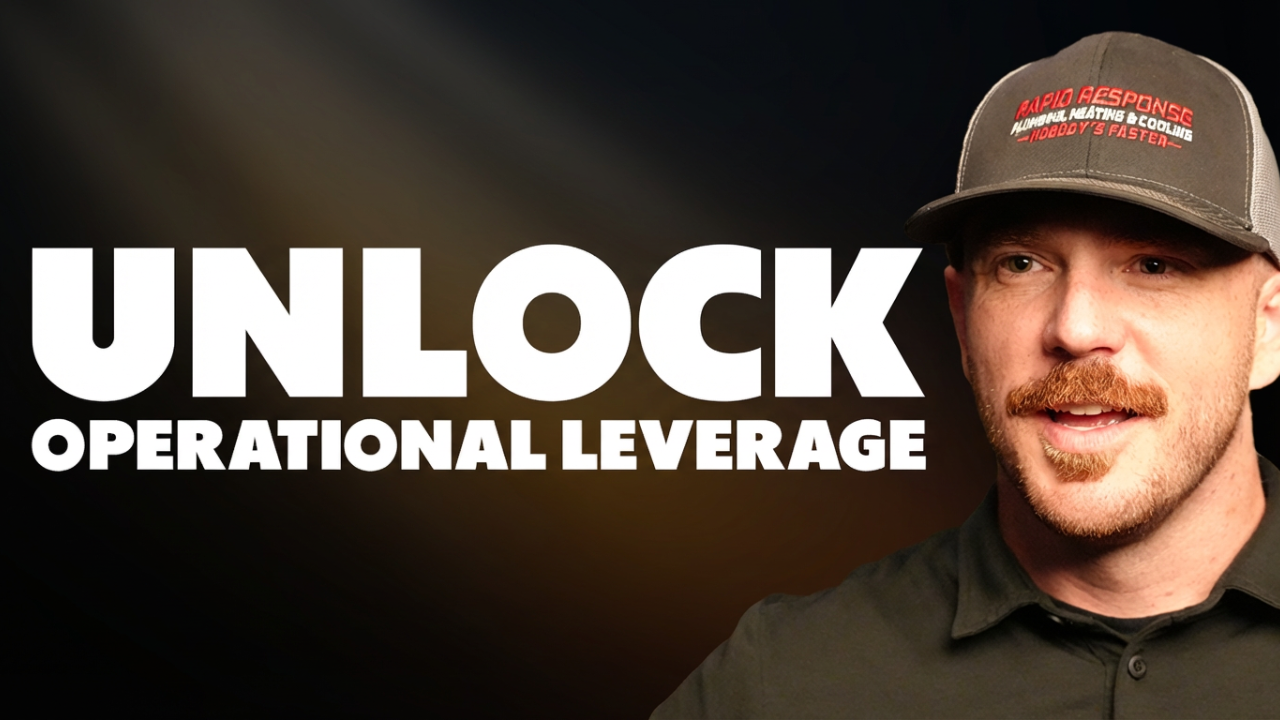
When I spoke with Collin Trimble, we kept circling the same idea, even when we were discussing acquisitions, customer experience, or recurring revenue.
Operational leverage is the real unlock.
Most service businesses do not stall because they lack leads or market demand. They stall because the business stops scaling once the owner’s time maxes out. Revenue grows linearly with effort. When the owner slows down, growth stops.
Colin sees this constantly in security businesses, but the pattern is identical in HVAC, plumbing, electrical, and every trade-based service business.
The business works.
Customers are loyal.
Revenue is predictable.
But the owner is the system.
That is not a growth problem. It is a leverage problem.
What Operational Leverage Actually Means
Operational leverage is not cutting costs or squeezing margins.
It is building a business where:
- One decision impacts hundreds or thousands of customers
- One hire unlocks capacity across multiple departments
- One process replaces dozens of ad-hoc conversations
Colin explained it simply. Many service businesses hit $2–3M and stall because the owner refuses to reinvest. At that level, they are finally comfortable. Writing checks to hire sales, invest in marketing, or upgrade systems feels risky.
So they protect income instead of building leverage.
That choice quietly caps the business.
The Counterintuitive Truth About Scale
Here is the part most owners get wrong.
Scale does not destroy customer experience.
Lack of process does.
Colin puts his personal phone number on the website. Thousands of customers have it. Almost none of them call. That is not because customers do not care. It is because the business communicates so clearly and so often that escalation is rarely needed.
That is operational leverage.
The customer experience does not rely on heroics. It relies on structure.
How to Unlock Operational Leverage in a Service Business
This is the part you can actually apply.
1. Build layers before you think you need them
If every issue routes to you, you have zero leverage. Service manager, ops lead, and customer experience roles exist to absorb noise so you can focus on decisions, not fires.
2. Systemize communication, not just execution
Most SOPs focus on how work is done. The best ones define when and how customers are updated. When communication is predictable, complaints drop without changing the quality of work.
3. Replace one-off fixes with repeatable processes
Colin talked about hundreds of steps in a single service workflow. That sounds heavy until you realize each step eliminates rework, confusion, or escalation. Leverage comes from doing things once and benefiting forever.
4. Reinvest while it still feels uncomfortable
Operational leverage is built before it is obvious. Hiring sales, investing in marketing, and upgrading systems always feels early in hindsight. Waiting for certainty is how businesses stay small.
5. Activate existing customers first
Leverage multiplies when you grow from what you already own. In Colin’s world, that means acquiring recurring accounts and systematically cross-selling services. In any service business, existing customers are the cheapest and fastest path to growth.
The Real Shift Owners Have to Make
Operational leverage requires a mindset change.
You are not paid to do the work.
You are paid to build the machine that does the work.
Owners who chase comfort protect today’s income.
Owners who chase leverage build businesses that outgrow them.
That is the difference between a $2M ceiling and a platform that compounds.
Once you stop being the system, the business finally starts to scale.